
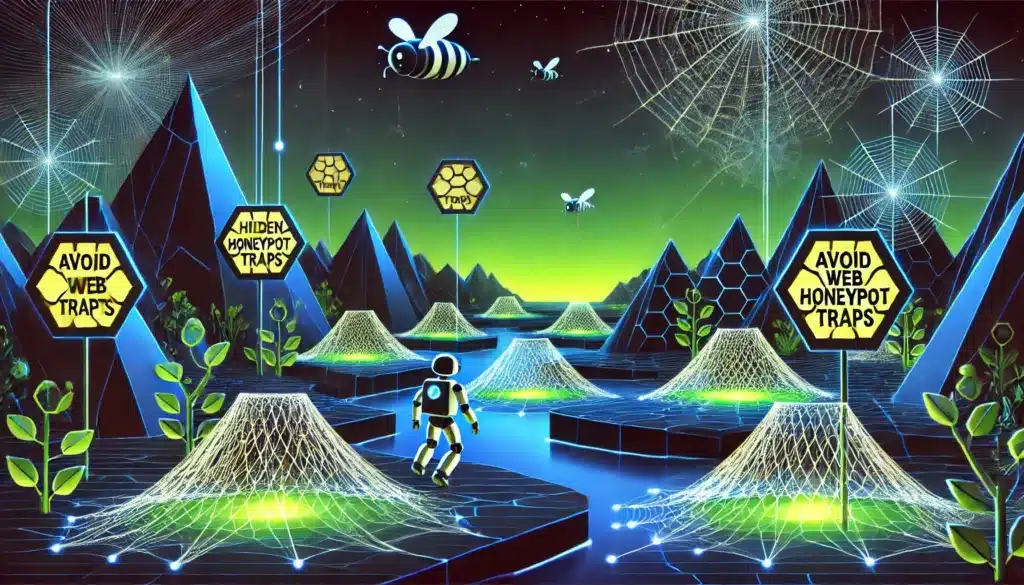
When you’re scraping the web, the last thing you want is to trip over a hidden honeypot trap. A sneaky trap called a honeypot is one that website owners set specifically to catch scrapers and bots.
In this article, we’ll walk through real examples of how honeypots work, why it’s critical to avoid them, and what actionable steps you can take to keep your scraping activities safe and efficient.
Whether you’re using proxies, rotating IPs, or advanced techniques like headless browsers, the right approach makes all the difference. Companies deploying rotating proxies with built-in anti-detection saw their block rates plummet by 30-50% in just three months. This guide will give you those same insights you need to scrape without falling into the hidden traps waiting for your bot.
What Exactly Is a Hidden Honeypot Trap in Web Scraping?
Table of Contents
ToggleThese traps are web pages or elements that are invisible to humans but easy for bots to find and click on. For example, imagine a website that inserts a hidden link outside the body tag of its HTML code. No human would ever see it, but a bot that doesn’t strictly follow HTML rules might end up following it, instantly exposing itself as a non-human visitor.
Honeypots are hidden code on a webpage with no visibility to the user when the HTML or JavaScript is rendered in their browser. When a legitimate user browses the webpage they will see the regular webpage. Bots, on the other hand, scan the code and interact with it. For example, a bot might click a link that the hidden code refers to or attempt to scrape a photo that wouldn’t be visible to a legitimate user
Source: Itay Binder, Cyber Security Research Manager at HUMAN Security
The moment your bot falls into one of these honeypots, you’re in trouble. Best case? Your IP gets banned. Worst case? Your IP gets blacklisted across multiple sites, your scraping efforts are ruined, and your proxy provider starts cutting ties because you’ve “dirtied” their IP pool. If things really go sideways, you might even get reported to your Internet Service Provider (ISP) for suspected hacking, potentially leading to service interruptions.
Also read: How to Avoid Getting Your SOCKS5 Proxies Blocked?
How Honeypots Trap Bots and Proxies?
Honeypots are designed to catch bots and proxies by luring them into areas they shouldn’t visit. Website owners use them to identify and block automated traffic, and they work in subtle yet effective ways. Let’s break down two common types of honeypots that can trap scrapers.
1. Email Honeypots
One of the oldest tricks in the book, email honeypots are invisible email addresses embedded in the source code of a website. Regular users cannot see these email addresses, but novice scrapers can. Once a scraper collects these hidden emails, the server knows it’s a bot because no legitimate user would ever see them.
For example, a website might hide an email address deep in the page’s code, never displaying it visually. If your scraper is programmed to collect emails from the HTML source without applying any filters, it will grab this honeypot address and mark your IP as suspicious. In no time, your IP could be flagged for sending spam or violating terms of service.
2. Robot Honeypots
Robot honeypots are even more sophisticated. They involve hidden links or entire pages on a site or page humans can’t see or access. These links might be placed outside the main content of the page, like in the HTML after the closing </body> tag, making them invisible to regular users. But a bot that doesn’t strictly follow proper HTML parsing rules could still stumble upon and follow these links.
Let’s say a site has a hidden link to a page that’s excluded in its robots.txt file. This file is there to tell bots which parts of the site they shouldn’t visit. But if a scraper ignores the robots.txt rules and follows the link anyway, that’s a major red flag. Any entity that accesses that link is instantly flagged as a bot. From there, the site can blacklist the bot’s IP or even report it to wider databases used by other websites.
Note that robots.txt is part of the Robots Exclusion Protocol, and it’s not authorization. It’s advisory guidance for well-behaved crawlers, not an access-control system. If something must be protected, use real security controls (auth/access rules), because disallowed paths are still publicly discoverable.
This kind of trap works because legitimate bots, like those from Google or Bing, respect the rules in the robots.txt file. But poorly coded scrapers don’t, and that’s exactly how they get caught.
Also read: How Often Do Crawlers Need to Rotate IPs and Why
Other Common Honeypot Patterns
Email and robots.txt traps are common, but modern sites also use behavior and visibility tricks. Here are four patterns scrapers trip over the most.
Hidden form fields
These are extra inputs that humans never see, but bots often fill automatically.
What it looks like: a field like website, company, or phone2 that should stay empty.
How it catches bots: if the field contains anything on submit, the request gets flagged.
Honeypot fields are typically hidden with CSS rather than type=”hidden”.
CSS-hidden links
These are normal links, but they’re visually hidden so real users never interact with them.
Common hiding styles to watch for: display:none, visibility:hidden, opacity:0, “off-screen” positioning (like left:-9999px), or a 1px element tucked into layout noise.
Scraping guides often call these out as a top honeypot signal.
Timing traps
Some sites combine honeypots with human-time checks.
How it works: a timestamp is set on page load, then the server rejects form submissions that arrive unrealistically fast (for example, under 2–3 seconds).
Humans read and type; bots tend to insta-submit.
Decoy link networks / labyrinths
Instead of blocking immediately, some defenses lure crawlers deeper into irrelevant pages or link mazes to burn crawl budget and identify automation patterns. Cloudflare has described AI labyrinth style approaches as a honeypot-like method for trapping crawlers with decoy content.
Treat visibility + intent as filters. If an element isn’t visible to real users, or a flow happens faster than a human could reasonably do it, don’t let your crawler interact with it.
Code Examples
Below are two small, practical patterns you can steal. The first is a lightweight BeautifulSoup filter for obvious hidden traps. The second uses Playwright to only follow links that are actually visible in the rendered page, which is the safest default when honeypots rely on CSS invisibility.
Example 1
Snippet in BeautifulSoup to ignore hidden inputs and skip suspicious hidden links.
from bs4 import BeautifulSoup
import re
from urllib.parse import urljoin

HIDDEN_STYLE_RE = re.compile(
    r"(display\s*:\s*none|visibility\s*:\s*hidden|opacity\s*:\s*0\b|"
    r"left\s*:\s*-\d+px|top\s*:\s*-\d+px|width\s*:\s*1px|height\s*:\s*1px)",
    re.I
)

SUSPICIOUS_CLASS_RE = re.compile(r"(honeypot|hidden|sr-only|bot-trap)", re.I)

def _looks_hidden(tag) -> bool:
    if tag.has_attr("hidden") or tag.get("aria-hidden") == "true":
        return True
    style = tag.get("style", "") or ""
    if HIDDEN_STYLE_RE.search(style):
        return True
    class_list = " ".join(tag.get("class", []) or [])
    if SUSPICIOUS_CLASS_RE.search(class_list):
        return True
    if tag.get("tabindex") == "-1":
        return True
    return False

def extract_human_visible_links(html: str, base_url: str) -> list[str]:
    soup = BeautifulSoup(html, "html.parser")

    # 1) Ignore likely honeypot inputs (hidden fields humans don't see)
    for inp in soup.select("input, textarea, select"):
        # 'type=hidden' is not the only trick, but it's a useful baseline
        if (inp.get("type") or "").lower() == "hidden" or _looks_hidden(inp):
            inp.decompose()

    links = []
    for a in soup.find_all("a", href=True):
        # 2) Skip anchors that look hidden or bot-trappy
        if _looks_hidden(a) or _looks_hidden(a.parent) if a.parent else False:
            continue

        href = a["href"].strip()
        if href.startswith(("javascript:", "mailto:", "tel:", "#")):
            continue

        links.append(urljoin(base_url, href))

    # Deduplicate while keeping order
    seen = set()
    out = []
    for u in links:
        if u not in seen:
            seen.add(u)
            out.append(u)
    return out
This is heuristic-based (BS4 cannot evaluate full CSS), but it catches the most common honeypot patterns without turning your crawler into a paranoid squirrel.
Example 2
Snippet in Playwright that collects only visible anchors, compares with raw HTML, and enqueues human-visible.
import asyncio
from urllib.parse import urlparse

from playwright.async_api import async_playwright
from bs4 import BeautifulSoup

def raw_html_links(html: str, base_url: str) -> set[str]:
    soup = BeautifulSoup(html, "html.parser")
    out = set()
    for a in soup.select("a[href]"):
        href = a.get("href", "").strip()
        if href.startswith(("javascript:", "mailto:", "tel:", "#")):
            continue
        out.add(href)
    return out

async def visible_dom_links(page) -> set[str]:
    # Playwright supports :visible in locators
    anchors = page.locator("a:visible")
    return set(await anchors.evaluate_all("els => els.map(a => a.href).filter(Boolean)"))

def same_site(url: str, root: str) -> bool:
    return urlparse(url).netloc == urlparse(root).netloc

async def crawl_seed(url: str) -> list[str]:
    async with async_playwright() as p:
        browser = await p.chromium.launch(headless=True)
        page = await browser.new_page()

        resp = await page.goto(url, wait_until="domcontentloaded")
        raw_html = await resp.text() if resp else (await page.content())

        raw = raw_html_links(raw_html, url)
        visible = await visible_dom_links(page)

        # What’s in raw HTML but NOT visible is often where traps hide
        # You can log this for debugging:
        # hidden_candidates = {u for u in raw if u.startswith("http") and u not in visible}

        queue = [u for u in visible if same_site(u, url)]
        await browser.close()
        return queue

if __name__ == "__main__":
    urls = asyncio.run(crawl_seed("https://example.com"))
    print("\n".join(urls[:30]))
Warning Signs of a Honeypot Before You Trigger It
Avoiding honeypots is about knowing what to look for before you trip the wire. Here are some common warning signs that can help you spot a honeypot before your scraper walks right into it.
1. HTML Anomalies
One of the first red flags is when links are hidden outside the usual structure of a webpage. For instance, legitimate links should be within the <body> tag of an HTML document. However, some honeypots deliberately place links outside the <body> tag or in obscure parts of the page where no human would typically interact.
Imagine your scraper finds a link in the <footer> section of a webpage. Nothing suspicious so far, right? But upon closer inspection, you realize the link is actually placed after the closing </body> tag, which makes it invalid for human users. As a bot, however, your scraper might still follow it leading straight into a honeypot. A legitimate browser wouldn’t even render this link, but a bot that’s not strict about HTML parsing might.
If you notice links sitting in unusual places or HTML that looks poorly structured on purpose, stop and reconsider before following those URLs.
2. Patterns in URL Structure
Another giveaway is the structure of the URLs you encounter. A well-maintained website typically has a robots.txt file that tells bots where they are and aren’t allowed to go. A clever honeypot might place trap URLs in sections explicitly forbidden in the robots.txt file. Following these links can lead to instant blacklisting.
For example, let’s say your scraper encounters a URL path like /private-directory/hidden-page that’s excluded in the robots.txt. If your bot ignores these exclusions and visits the page, the website can instantly flag your IP as suspicious. This is because no human should ever be able to reach that link, as it’s specifically marked off-limits for bots.
Sites can use robots.txt to restrict certain sections and track anyone who visits these excluded areas. Coupled with hidden links, they can confidently identify bots that don’t follow standards.
Source: Alexandru Eftimie, CEO at Helios Live, former CTO at Microleaves
The takeaway? Always check the robots.txt file before deciding which URLs to scrape. If you see a link leading to a section that’s been marked off-limits, don’t risk it.
Also read: How to Prepare Effective LLM Training Data
Consequences of Falling Into a Honeypot
When you stumble into a honeypot while scraping, the consequences can be pretty severe. It’s not just a matter of being blocked from one site—it can spiral into much bigger issues, affecting your entire operation. Let’s break down the most common outcomes when you trigger a honeypot.
1. IP Banning
The most immediate result of falling into a honeypot is having your IP address banned from accessing the site you were scraping. This happens because once you access a honeypot, the website knows you’re not following normal user behavior, and it takes action to prevent further scraping.
For instance, imagine you’re running a scraping job and accidentally hit a honeypot. The site detects this unusual activity and blocks your IP address. From that moment on, no matter what you try to access on that site, it’s off-limits. You’ve lost access to that data source, and you’ll need to switch to a new IP to continue scraping. While this might seem like a minor inconvenience, it’s often just the beginning.
2. Blacklisting
Getting banned from one site is bad, but the situation can get worse if your IP is added to a blacklist, a shared database of known bot activity. Many websites rely on third-party blacklists to protect themselves from scraping, so if your IP ends up on one of these lists, you’re going to have a hard time scraping any site that uses the same blacklist for defense.
In this scenario, you might notice that after hitting the honeypot, your scraper starts experiencing slow response times or getting denied access across multiple sites. That’s because your IP has been flagged, and now multiple sites recognize it as a bot. You’ve essentially been locked out of a large chunk of the web.
3. ISP Reporting
In the most extreme cases, repeated run-ins with honeypots can lead to your ISP (Internet Service Provider) stepping in. If a website reports your IP for abusive behavior, and it happens often enough, your ISP might decide to suspend your service. This isn’t a common occurrence, but it’s definitely a possibility if you’re scraping without proper precautions and keep getting flagged by multiple sites.
Imagine this: You’ve been scraping heavily, and your operation has triggered several honeypots over time. After enough reports to your ISP, you suddenly find your connection throttled or your service temporarily suspended. This is a worst-case scenario, but it’s something that every scraper needs to be aware of and prepared to avoid.
Also read: How to Avoid Network Honeypots?
Tools and Techniques to Avoid Honeypots
Avoiding honeypots while scraping is about having a good strategy and using the right tools and techniques. One of the most popular methods is proxy rotation, but as useful as it is, it’s not a magic bullet. Here’s what you need to know to avoid honeypots more effectively.
1. Proxy Rotation: A Solid First Line of Defense
Proxy rotation involves switching between different IP addresses to make it look like multiple users are accessing the site, rather than just one bot. This can help you spread out your traffic and reduce the chance of detection.
Think of it like rotating through different phone numbers when making calls. If one number gets blocked, the others can still be used. In scraping, this means you won’t hammer a website with requests from the same IP, which could raise flags and lead to a ban.
However, simply rotating proxies isn’t enough on its own. Proxy rotation can help distribute your traffic, but if you’re using proxies from the same IP pool repeatedly, you’re still at risk of getting flagged. This leads us to the next point.
2. Limitations of Proxy Rotation
While rotating proxies offers some protection, it has limitations. If you’re using proxy servers from the same IP pool, websites may start to notice patterns, especially if they’ve already set up honeypots. Many honeypots are designed to catch not just single IPs but groups of IPs that behave in a way bots typically do—making similar requests or accessing the same hidden pages.
For example, say you’re using a pool of proxies from a popular provider, and a honeypot flags one of the IPs in that pool. Even though you’re rotating through several IPs, if too many are recognized from the same provider, you could still be blacklisted.
That’s why you need to be careful when choosing and rotating proxies. Don’t rely on a small set of IPs and assume you’re in the clear just because they’re different from each other.
3. Best Proxy Types: Residential Proxies for the Win
When it comes to avoiding honeypots, the type of proxy you use is just as important as how you rotate them. The safest option is to use residential proxies. These IP addresses are those that Internet Service Providers (ISPs) have assigned to actual households, so they closely resemble actual real users.
Unlike data center proxies, which are more easily flagged as bot traffic because they come from server farms, residential proxies make it harder for websites to differentiate between human users and scrapers. Residential proxies are your best bet because they blend in with normal web traffic.
Let’s say you’re scraping an e-commerce site and rotating through residential proxies. The IP addresses you’re using look like they belong to real users browsing the site from their home internet connections.
4. Headless Browsers: The Power of Rendering Pages
One of the most effective ways to avoid honeypots is by using headless browsers in your scraping operations. Unlike traditional scrapers that just pull the raw HTML, a headless browser fully renders the page just like a human browser would allowing you to see the page exactly as a real user does. This can help you spot traps before you stumble into them.
Additionally, headless browsers enable you to interact with web pages dynamically, allowing you to execute JavaScript, handle cookies, and navigate through links just as a regular user might.
Also, you can analyze websites using inspect element to better understand their structure and identify hidden elements. By leveraging these tools, you can detect unusual patterns or scripts designed to flag automated tools, further minimizing the risk of landing in a honeypot.
A headless browser operates without a graphical interface but functions exactly like a normal browser under the hood. It loads JavaScript, renders dynamic content, and shows you everything that a real user would see when visiting the website. This ability makes headless browsers a powerful tool for detecting honeypots, as you can ensure you’re only following legitimate links visible to human users.
Examples
For example, let’s say you’re scraping a website with a hidden honeypot link embedded somewhere in the page’s code. A standard scraper might automatically follow that link because it exists in the raw HTML, but a headless browser will actually render the page first. This lets you check if the link is something a human user would ever see or click on. If it’s hidden, you know not to follow it.
A scraper using a headless browser renders the entire page, checks if all links are visible in the browser window (i.e., not hidden in obscure sections like the <footer> or outside the <body> tag), and only proceeds to navigate the ones that a human would reasonably interact with.
Rendered DOM vs Raw HTML
When you scrape a page, there are two realities:
- Raw HTML is the response body your scraper downloads and parses. It includes everything the server returns, including links and inputs that may never be shown to users.
- Rendered DOM is what a browser builds after it runs JavaScript and applies CSS. This is what a human actually sees and can interact with.
That distinction matters because many honeypots are designed to be present in raw HTML but effectively invisible in the rendered page. A basic HTML scraper can see and follow traps that a real user would never click, like CSS-hidden links or hidden form fields.
Use raw HTML to extract data, but use the rendered DOM to decide what’s clickable. In other words, only enqueue links that are visible to a real user (Playwright/Selenium visibility checks), and treat “in HTML but not visible” elements as honeypot candidates you should skip and log.
The Role of CAPTCHA and Honeypots
When it comes to web scraping, CAPTCHAs and honeypots are often lumped together, but they serve different purposes. CAPTCHAs are designed to directly challenge whether you’re a bot or a human, while honeypots are more like sneaky traps lying in wait to catch bots in the act. The key difference is that CAPTCHAs aren’t trying to trick you, but improper handling of them can still get your scraper flagged. Bypassing captcha for web scraping can lead to smoother data extraction processes and many developers resort to various strategies to avoid CAPTCHAs, such as using proxy servers or sophisticated algorithms designed to mimic human behavior.
A CAPTCHA system is typically not considered a honeypot. CAPTCHAs are an explicit challenge, requiring users to complete a task that’s easy for humans (like identifying objects in images) but tough for bots. If your scraper hits a CAPTCHA, it’s not because you triggered a honeypot. It’s a direct attempt to verify you’re human.
An easy trap to fall into when scraping forms is the hidden field honeypot. Many websites will include hidden form fields that regular users don’t see, but a bot might attempt to fill out all the fields indiscriminately. Scrapers that automatically fill every field, including these hidden ones, essentially trigger an alarm.
Example: Let’s say you’re scraping a registration form. There’s a hidden field in the form’s HTML that isn’t displayed to human users. A well-built scraper would ignore this field because no legitimate user would interact with it. But if your bot fills out this hidden field and submits the form, you’ve just flagged yourself as a bot.
In the same way that honeypots trick bots by setting invisible traps, these hidden fields work like a honeypot within forms. If your scraper isn’t careful, it can reveal itself as a bot simply by filling out too much information.
Also read: Top 5 Best Rotating Residential Proxies
Best Practices for Safe Scraping
When scraping websites, it’s easy to start gathering as much data as quickly as possible. But scraping is not a sprint. You have to stay under the radar and avoid traps like honeypots. Here are a few key practices that can help you scrape safely without causing trouble.
Don’t Overload the Site
One of the fastest ways to catch you is when you hit a website too hard. Scraping at a high rate, such as making 300 requests per second, is a sure way to raise red flags. No human would be clicking through a site that fast, and web admins will notice the unusual spike in traffic.
Instead, pace your scraper to resemble normal browsing behavior. Slow it down, space out your requests, and even consider using random intervals between them. This doesn’t just help you avoid detection—it’s also respectful to the site’s server resources.
Mimic Human Behavior
The key to effective scraping is to make your bot act like a human. Think about how often a person would click through pages, how long they might spend reading an article, or when they’d be scrolling. Your bot should follow a similar pattern.
For instance, sending multiple requests per second or constantly navigating through a site with no breaks will end up flagging you as a bot. Adding delays between requests and randomly simulating human interaction patterns can go a long way in staying undetected.
Let’s say you’re scraping a product catalog. Instead of grabbing hundreds of product pages in quick succession, space your requests out, take breaks, and interact with different pages as a human would. Even better, occasionally skip around to different parts of the site to make your activity appear less predictable.
Avoid Restricted Areas
If a website has a robots.txt file that excludes certain sections, it’s generally a good idea to respect it. The robots.txt file is a signal from the website owner about what parts of their site they don’t want crawled. Disregarding it can also lead you directly into honeypots or restricted areas designed to catch scrapers.
That said, there are cases where you might feel the need to scrape something despite its exclusion in the robots.txt. If so, be prepared to handle the risks, and set up your bot to avoid obvious traps like honeypots.
You encounter a section of a website excluded in robots.txt, but your bot clicks on a link to that section anyway. By doing so, you risk triggering a honeypot designed for bots that ignore these rules. A smarter approach is to stick to allowed areas, where you’re less likely to encounter problems.
Also read: Tips for Crawling a Website
The Future of Honeypots and Scraping
The biggest shift is that honeypots are becoming more web-native and behavior-based, not random hidden links you can dodge with simple rules. Many defenses are designed specifically for AI crawlers and large-scale scrapers that ignore no-crawl signals, so the traps look more like normal internal navigation, just with a twist that only bots will follow.
Emerging Trends
1) Decoy link networks and AI labyrinths
Some defenses quietly add invisible links that humans never see, leading bots into endless decoy pages. Cloudflare’s AI Labyrinth is a clear example: it uses hidden links and AI-generated decoy content to waste crawler resources and help fingerprint bots that shouldn’t be there.
2) Visibility-based traps
Modern honeypots often exist in raw HTML but are invisible after CSS/JS rendering. If your crawler follows everything in HTML, it’s easier to bait.
3) Behavior scoring over single events
Instead of banning you for one mistake, many stacks build confidence over time: link depth, click timing, navigation patterns, cookie behavior, and repeated impossible actions.
What to Expect?
- More traps that don’t block immediately. They’ll lure bots into low-value paths to learn patterns and collect fingerprints before taking action.
- More AI-crawler-specific mitigations. Some platforms are moving toward default restrictions for known AI crawlers and stronger enforcement beyond robots.txt alone.
- Scraper takeaway: treat human visibility as a safety rule. Use headless browsing to render the page, then only enqueue links a user could actually see and reasonably click.
Also read: Free Libraries to Build Your Own Web Scraper
Conclusion
Honeypots are the silent but dangerous traps that can ruin your day. To catch scrapers unaware, webmasters put in place these covert mechanisms, and the result can be IP bans, blacklisting, or worse.
Any scraper worth their salt needs to be familiar with the inner workings of honeypots, whether they take the form of hidden links or embedded email addresses. By recognizing the warning signs, such as HTML anomalies or unusual URL patterns, you can significantly reduce your chances of triggering these traps.
But it doesn’t stop there. Employing the right tools and techniques, like headless browsers and residential proxies, helps you navigate the web more safely. Mimicking human behavior and adhering to best practices will maintain a healthy relationship with the sites you scrape.
The hidden honeypot trap is evolving, and modern defenses now include decoy link networks and AI crawler traps, so scrapers need to adapt continuously
FAQs About Hidden Honeypot Traps
Q1. What is a honeypot trap in web scraping?
A honeypot trap is a hidden web element designed to catch bots and scrapers. These traps include invisible links, hidden form fields, or pages placed outside normal HTML structure that humans never see but bots can detect. When your scraper interacts with these elements, it reveals itself as a bot, leading to IP bans or blacklisting.
Q2. How do honeypot traps detect bots?
Honeypots detect bots through invisible elements like hidden links placed after closing body tags, CSS-hidden form fields, or pages excluded in robots.txt files. Bots that don’t strictly follow HTML parsing rules or ignore visibility checks will interact with these traps, instantly exposing themselves as automated traffic rather than human visitors.
Q3. What happens if my scraper triggers a honeypot?
Your IP gets immediately banned from the website. Worse, your IP may be added to shared blacklists used across multiple sites, blocking you from scraping numerous websites. In severe cases, repeated honeypot triggers can result in reports to your ISP, potentially causing service interruptions or suspensions.
How useful was this post?
Click on a star to rate it!
Average rating 0 / 5. Vote count: 0
No votes so far! Be the first to rate this post.
Tell Us More!
Let us improve this post!
Tell us how we can improve this post?